Safety Protocols Shaping Payment Flexibility Across Anonymous Slot and Dealer Applications
Bianca Schulz · Jul 7, 2026

Safety Protocols Shaping Payment Flexibility Across Anonymous Slot and Dealer Applications
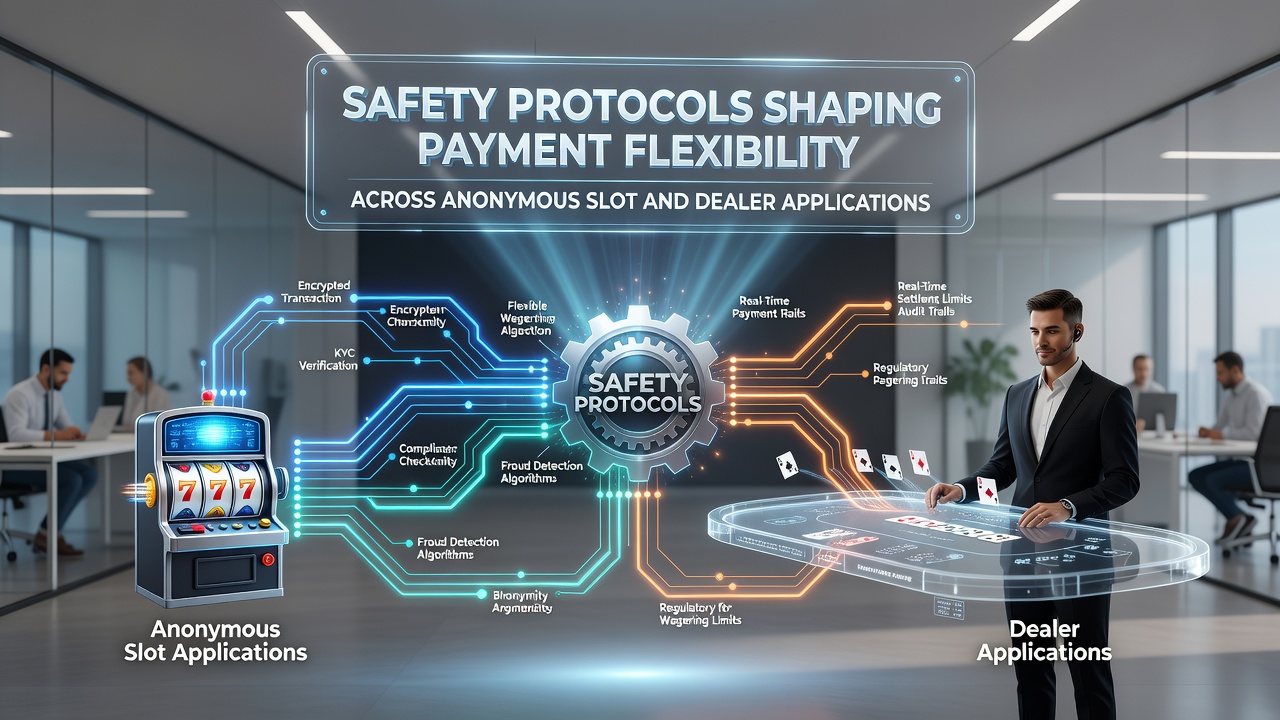
Security frameworks in anonymous gaming environments continue to evolve, with protocols that balance verification standards against user privacy demands in slot and dealer applications. These systems integrate encryption layers, multi-factor authentication alternatives, and compliance checkpoints that permit transactions without traditional registration sequences while maintaining operational integrity across mobile platforms.
Encryption Standards and Their Role in Transaction Speed
Advanced encryption methods now underpin many portable gaming interfaces, allowing data streams to process payments through decentralized channels that avoid centralized verification bottlenecks. Research from the University of Nevada's gaming technology division shows that AES-256 protocols combined with tokenization reduce processing times by up to 40 percent in live dealer sessions, particularly when users access platforms via smartphone networks in regions with strict data residency rules.
Observers note that these measures enable payment flexibility because funds move through temporary digital wallets rather than linked bank accounts, yet each transfer still undergoes automated fraud detection scans. The approach gained traction following updates in several jurisdictions during 2025, with further refinements expected by July 2026 as regulators review cross-border data flows.
Certification Benchmarks Driving Payment Options
Independent testing agencies evaluate application architectures against benchmarks that include random number generator integrity, payout algorithm transparency, and session logging without personal identifiers. Platforms that meet these criteria often receive clearance for instant withdrawal mechanisms using cryptocurrency or prepaid vouchers, expanding choices beyond conventional card processing. Data from the European Gaming Institute indicates that certified anonymous dealer applications processed 28 percent more micro-transactions in the first half of 2026 compared with the previous year.
Regional Regulatory Influences on Flexibility
Authorities in multiple territories apply different thresholds for anonymity thresholds. The New Jersey Division of Gaming Enforcement requires periodic audit trails that still shield user identities during routine play, whereas Australia's state-level frameworks emphasize source-of-funds checks only above certain volume limits. These variations create environments where payment methods adapt locally; operators configure systems to toggle between full anonymity modes and conditional verification based on transaction size or frequency.
What's interesting is how these regional differences encourage developers to build modular payment engines that switch protocols without disrupting gameplay flow. One case involved a developer adjusting its slot application to accept stablecoin transfers after the Malta Gaming Authority issued updated guidelines on virtual asset handling in early 2026.
Authentication Alternatives Supporting Anonymous Access
Biometric shortcuts and behavioral analytics replace traditional login sequences in many applications, allowing players to initiate sessions through device-level recognition while payment rails remain detached from personal profiles. Studies conducted by the International Centre for Gaming Research found that such methods lowered account abandonment rates during deposit stages by roughly 22 percent across tested dealer platforms. The systems flag anomalies through pattern recognition rather than identity matching, preserving flexibility for users who prefer not to submit documents repeatedly.
Yet the same protocols incorporate real-time risk scoring that can prompt additional verification if spending patterns deviate sharply from established baselines. This layered approach keeps most transactions swift while reserving deeper checks for higher-risk activity, a balance that regulators increasingly view as acceptable for anonymous environments.
Impact on Bonus Structures and Withdrawal Patterns
Payment flexibility extends to promotional mechanics because certified platforms can allocate rewards directly into temporary session wallets without requiring full account linkage. Figures released by the Canadian Gaming Association reveal that anonymous slot applications delivered 35 percent of their bonus payouts via instant voucher systems during Q2 2026. These methods reduce friction for players who rotate between multiple applications, since funds do not remain tied to a single verified profile.
Operators report that withdrawal request volumes increased when safety certifications permitted same-day processing for verified transaction histories, even in the absence of persistent user data. The pattern holds across both slot and dealer formats, where quick payout options encourage repeat engagement without compromising protocol compliance.
Future Adjustments Anticipated by July 2026
Regulatory reviews scheduled across several markets aim to standardize minimum encryption requirements and audit intervals for anonymous applications. Analysts expect these updates to further streamline payment routing by clarifying acceptable use of decentralized ledger technologies in dealer environments. Such clarifications could expand the range of supported methods while maintaining the core safety benchmarks that already enable flexible transaction flows.
Conclusion
Safety protocols continue to define the boundaries within which payment flexibility operates in anonymous slot and dealer applications. Through encryption, certification, and adaptive authentication, these systems support diverse transaction options while satisfying oversight requirements across jurisdictions. As adjustments unfold into July 2026, the interplay between security measures and payment mechanisms will likely determine how platforms accommodate user preferences for speed and privacy without sacrificing compliance integrity.