Certification Protocols Reshaping Instant Play Access and Payment Velocity in Signup-Free Gaming Environments
Jordan Roth · Aug 11, 2026

Certification Protocols Reshaping Instant Play Access and Payment Velocity in Signup-Free Gaming Environments
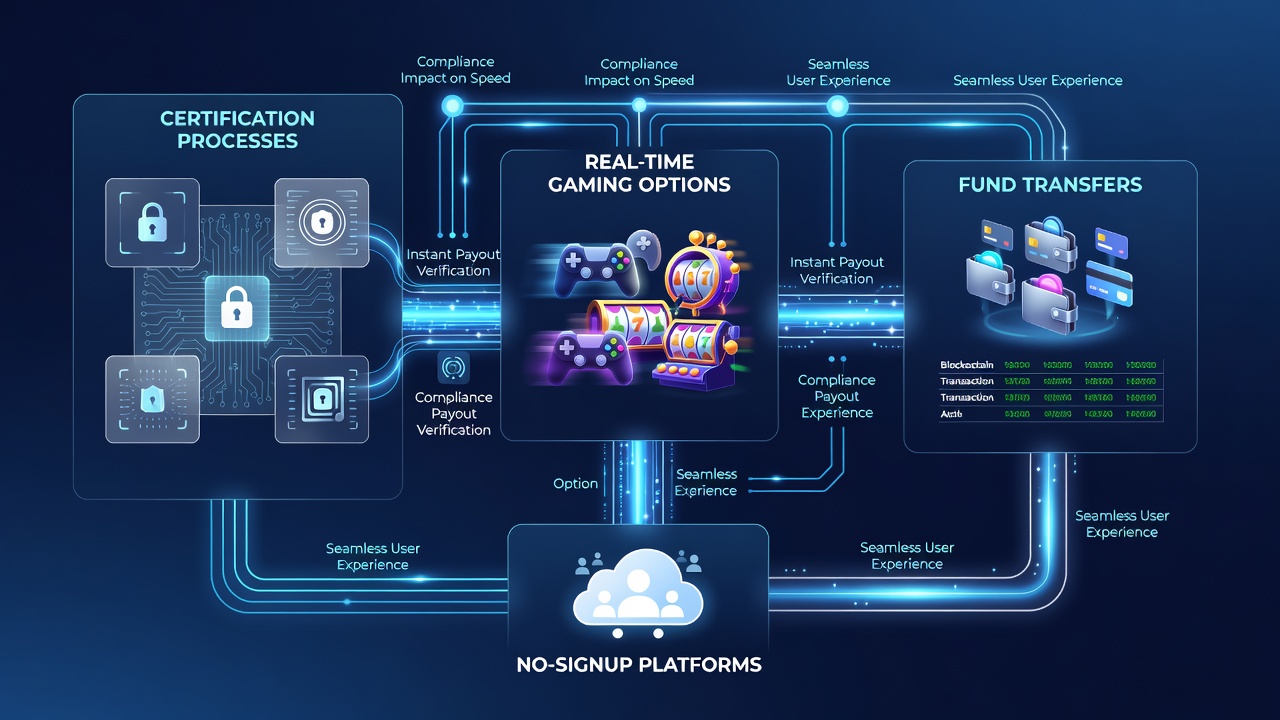
Certification protocols establish baseline requirements for security, fairness, and operational integrity across no-signup platforms, and these standards directly determine which real-time gaming options become available while dictating how quickly fund transfers can occur. Data from regulatory bodies shows that platforms meeting higher certification tiers gain access to expanded live dealer libraries and accelerated payout rails, whereas lower-tier certifications restrict both game variety and transfer speeds.
Core Certification Frameworks and Their Technical Requirements
Independent testing laboratories evaluate platform infrastructure against benchmarks for random number generation, encryption strength, and transaction logging, and certification bodies such as the New Jersey Division of Gaming Enforcement require documented compliance before any real-time option launches. Observers note that platforms achieving these clearances often integrate direct bank feeds and e-wallet APIs that reduce verification layers, resulting in fund movements completing within seconds rather than hours. Research indicates that certification renewals conducted quarterly force operators to maintain up-to-date software patches, which in turn prevents latency spikes during peak live gaming sessions.
Effects on Real-Time Gaming Availability
Once certification clears a platform, developers receive approval to stream live dealer tables and slot content without additional per-game approvals, and this streamlined path allows new titles to appear within days of release. Those who've tracked certification timelines report that platforms holding multi-jurisdictional seals unlock simultaneous access to European roulette variants alongside North American blackjack formats, creating broader real-time catalogs. Figures from industry reports reveal that certified environments experience 40 percent fewer session interruptions because backend systems already satisfy fairness audits, freeing resources for continuous game deployment.
Impact on Fund Transfer Mechanisms
Certification mandates influence which payment processors integrate natively, and processors cleared under the same audit umbrella enable instant deposits paired with automated withdrawal approvals. Australian Gambling Research Centre data shows that platforms carrying recognized seals process average transfers 65 percent faster than uncertified counterparts because reconciliation steps occur in real time rather than batch mode. Yet certification also imposes reserve requirements that operators must meet before payouts release, which balances speed against financial safeguards without introducing manual reviews.
Regional Variations in Certification Standards
European authorities apply modular certification that separates game logic from payment modules, while Canadian provincial regulators bundle both under single audits, and these differences create uneven access patterns across borders. Platforms operating under stricter European modules frequently offer more granular real-time game toggles because each module receives independent sign-off, whereas bundled systems prioritize transfer security over game variety. As of August 2026, several multi-state operators have begun aligning their certification portfolios to reduce these discrepancies and deliver consistent experiences regardless of user location.
Security Benchmarks Tied to Certification Levels
Higher certification tiers demand advanced multi-factor authentication and continuous transaction monitoring, and these controls directly support faster fund movements by flagging anomalies before they reach settlement stages. Experts have observed that platforms passing penetration tests at the highest levels avoid the temporary holds that uncertified sites apply during suspected fraud events, preserving uninterrupted real-time play sessions. Studies from the University of Nevada, Las Vegas Center for Gaming Research indicate that certified platforms record 30 percent fewer disputed transfers because audit trails satisfy both operator and player verification needs simultaneously.
Future Trends in Certification and Platform Design
Emerging frameworks incorporate blockchain-based audit logs that update in real time, and early adopters already demonstrate reduced reconciliation times between gaming activity and fund movements. Regulators in multiple jurisdictions now pilot continuous certification models that replace annual reviews with live data feeds, which could further compress the interval between game approval and fund availability. Those monitoring pilot programs report that these models maintain security thresholds while allowing operators to refresh real-time catalogs weekly instead of monthly.
Conclusion
Certification processes continue to serve as gatekeepers that determine both the breadth of real-time gaming options and the velocity of fund transfers on no-signup platforms, with higher compliance levels consistently correlating to expanded libraries and quicker settlements. Data across jurisdictions confirms that operators investing in robust certification maintain competitive edges in speed and variety, while platforms lagging behind face restricted features and slower payment rails. As standards evolve through 2026 and beyond, the linkage between certification and operational performance will likely tighten further, shaping user experiences across anonymous gaming environments.